Posts

Showing posts with the label s- and p- block

The Most Noble Complex Compound
Image
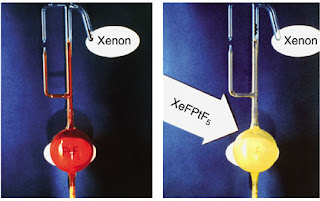
Bartlett's oxidation of Xe using PtF 6   The noble gas compounds have been a great interest since the creation of its kind, XePtF 6 , in 1962. Since then, many xenon compounds with direct bonds to fluorine, oxygen, nitrogen, carbon, xenon itself, and chlorine have been established. However, all these bonded atoms are electronegative main-group elements but there have been several indications that metal-xenon bonds can be formed and detected such as (CO) 5 Mo...Xe. Besides that, The Au-Xe + has been detected by mass spectroscopy and has been calculated with a best estimate for the bond distance of 257 pm. Researchers from Germany successfully created the first metal-xenon square planar compound with direct Au-Xe bond.

Compounds of s- and p- Block Elements

Image
In this section, we will have a survey in elements of s - and p - block elements. Since, the elements of s-  and p - block is varies, we only have a look for binary compound of hydrogen, oxide, and halides; as well we will see the trends in the periodic table. Binary compounds of hydrogen The s- and p- block elements can form binary compound with hydrogen and as the characteristic of the elements varies, the types of compounds are also different. Group 1 and 2 metals form ionic (saline or salt like) compound with the hydrogen has -1 charge ( H − ), with exception of Be and Mg. The ionic hydrides is a compounds with electropositive s -block metals, so it can make hydrogen to form  H − . 

Solid State Chemistry and the Standard Enthalpy of Dissolution (The Periodic Trends)

Image
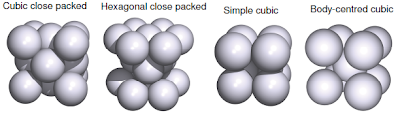
In this section we will see the solid structure of metals and their ionic compounds of  s - and p - block elements. Besides that, we will also see the lattice enthalpy and the enthalpy of dissolution of ionic compounds, as well their periodic trends. Solid State Structures of Metals In general, the metallic elements would arrange itself in metallic lattice in the most efficient was in a fixed volumes. Then, it is assume that atoms as hard spheres and all atoms have identical size. From those assumption, there are 4 main solid state structures of metals; cubic close packed (CCP), hexagonal close packed (HCP), simple cubic, and body-centred cubic. The elements will arrange in certain crystal lattice depends on its atomic (metallic) radius, and most of metals are CCP or HCP. Metallic solid structures

A Survey of the s- and p- Block Elements

Image
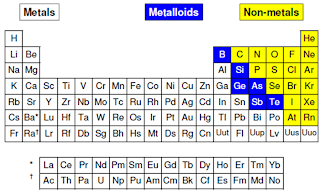
In this section we will have a look for a brief survey of the s - and p -block elements. We will have a look a certain properties of the elements across the group and as well their trends for some properties.

Group 14 Elements

Image
In this part we will have a brief view about group 14 elements. This part will see the occurrence of group 14 elements, the chemical properties (1st ionisation energy and electron affinity, covalent radius, and Pauling electronegativity scale), the physical properties (melting and boiling point), the allotropes, and the compounds of group 14 elements (the oxidation states, oxides, and chlorides).  From left to right: carbon, silicon, germanium, tin, and lead