Posts

Showing posts with the label synthetic methodologies

How Trivial is It to Make Amides?

Image
Amide is one of the organic functional groups that can be found ubiquitously in the nature. It plays important role in living things as the main building blocks of proteins which involve with many functions, from catalysis to structural support. Besides that, amide functionality is featured in many natural products and drugs. Examples of peptide-bearing compounds Since, it is quite common to find this functionality in natural products and synthetic compounds, a question is raised from this phenomenon. How trivial is it to make amide bond?


A (Brief) History of the Chemistry of Natural Products

Image
In these days, the chemistry of natural products is still a massive attraction for chemists, especially organic synthetic chemists. New substances, more or less complicated, more or less useful, are constantly discovered and investigated with all the techniques and tools that the early organic chemists could only imagine. In the course of these studies, the researchers are challenged by the preparation of the compounds which somehow drives this field forward. This time, we'll see the historical perspective of this 'ancient' research field and also future prospective that chemistry of natural products can offer.

Chiral Auxiliary Controlled Reactions

Image
Previously, in asymmetric aldol reaction a chiral enolate is used to ensure diastereoselective reaction by introducing more control due to chiral centre at enolate or carbonyl. This time, another method is used to synthesis an enantiopure product which is using chiral auxiliary functional group. Chiral auxiliary-controlled aldol reaction In this method, an enantiopure auxiliary (X C ) is used and it carries out a diastereoselective reaction such as aldol reaction. Furthermore, the reaction provides enantiopure product after removal of the chiral auxiliary.

Asymmetric Aldol Reactions

Image
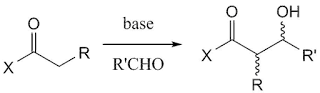
One of the well-known reactions in C-C bond formation is aldol reaction. This robust reaction has a great potential in controlling two stereocentres of the product. General aldol reaction The control on the stereocentres of the product is determined from the stereochemistry of the formed enolate; Z - and E - enolates would give different control on the outcome of aldol products.

Synthesis of Heteroaromatic Compounds: Indoles and 6-Membered Rings

Image
In this section, we will see the synthesis of other types heteroaromatics which are indoles and 6-membered rings. Unsurprisingly, those classes of heteroaromatics are common in the organic compounds such as in pharmaceutical and in natural products.  This syntheses will be carried in the same principles as the 5-membered ring heteroaromatics, which is carbonyl chemistry.

Mannich reaction

Image
The Mannich reaction is an organic reaction which consists of an amino alkylation of an acidic proton placed next to a carbonyl functional group with formaldehyde and ammonia or any primary or secondary amine . The final product is a β-amino-carbonyl compound also known as a Mannich base . Reactions between aldimines and α-methylene carbonyls are also considered Mannich reactions because these imines form between amines and aldehydes. The reaction is named after chemist Carl Mannich . [2] [3]

Preparation of Phenol

Image
Reaction of Benzene Sulfonic Acid with Hydroxide Reaction type : Nucleophilic Aromatic Substitution Summary This is a useful industrial method for the synthesis of phenol. Reagents : Usually NaOH, 300-350 o C followed by an acidic work-up to neutralize the phenoxide. This represents the oldest method for the industrial preparation of phenol. The reaction occurs via the addition-elimination mechanism with SO 3 2- functioning as the leaving group.