Posts

Showing posts with the label asymmetric synthesis

Strictamine

Image
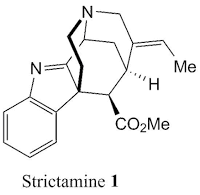
It was isolated for the first time in 1966 from the plant Rhazya stricta , strictamine (1)  has been a great interest due to its unique properties. Strictamine belongs to the group of akuammiline alkaloids which is the family of monoterpenoid indole alkaloids. This compound has been showed to inhibit the nuclear factor-𝜅B (NF-𝜅B), which plays an important role in immune and inflammatory responses. Apart from its bioactivity, strictamine has attracted synthetic chemists because its structure bearing a tricyclic unit of methanoquinolizidine. This interesting challenge causes only four groups - Garg (enantioselective), Zhu (racemic), Ohno (formal synthesis), and Gaich (formal synthesis) - have managed to complete a total synthesis of strictamine. This time on " Totally Synthesised" , we will see synthetic strategy by Gaich's group which used [2,3]-Stevens rearrangement to build the methanoquinolizidine unit.

Chiral Auxiliary Controlled Reactions

Image
Previously, in asymmetric aldol reaction a chiral enolate is used to ensure diastereoselective reaction by introducing more control due to chiral centre at enolate or carbonyl. This time, another method is used to synthesis an enantiopure product which is using chiral auxiliary functional group. Chiral auxiliary-controlled aldol reaction In this method, an enantiopure auxiliary (X C ) is used and it carries out a diastereoselective reaction such as aldol reaction. Furthermore, the reaction provides enantiopure product after removal of the chiral auxiliary.

Asymmetric Aldol Reactions

Image
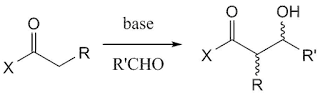
One of the well-known reactions in C-C bond formation is aldol reaction. This robust reaction has a great potential in controlling two stereocentres of the product. General aldol reaction The control on the stereocentres of the product is determined from the stereochemistry of the formed enolate; Z - and E - enolates would give different control on the outcome of aldol products.

Carbonyl Addition: Bürgi-Dunitz angle and Felkin-Anh control

Image
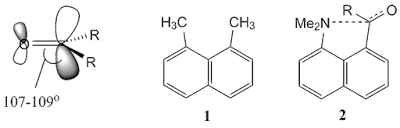
In nucleophilic addition in carbonyl compounds, it involves breaking π(C=O) bond by adding electrons into C=O antibonding orbitals. This implies the trajectory of attack for addition of a nucleophile follows the shape  of π*(C=O) allowing proper overlap with the orbitals. The trajectory of this nucleophile is around 107-109° and this angle is called Bürgi-Dunitz angle; named after H. B. Bürgi and J. D. Dunitz who discovered the physical evidence that supports the this angle of attack (H. B. Bürgi, J. D. Dunitz, and E. Shefter, J. Am. Chem. Soc., 1973, 95 , 5065-5067). Bürgi-Dunitz angle and the evidence of the trajectory of nucleophilic attack.