Posts

Showing posts with the label Physical Chemistry

Methodologies in Gas-Phase Spectroscopy for Study of Polypeptides

Image
The secondary structures of proteins, such as α-helices, β-sheets, or β- or γ-turns, mainly determine the overall 3-dimensional structures of protein and these structures are mainly stabilised by interactions such as hydrogen bonding (H-bonding) and dispersion interactions. Besides that, the interaction with its biological environment also contributes to the overall structure which means the intrinsic properties of the protein are hidden. Therefore, to have a better understanding about protein structure, proteins or polypeptides must be in isolated condition where no solvent molecules are present. One of the methods that can be used to study peptides in this isolated is gas-phase spectroscopy. 3D structure of myoglobin with α-helices and random coils are shown

Anionic and Cationic Polymerisations

Image
The other types of chain polymerisations, besides free radical polymerisations, are anionic and cationic polymerisation. In this case, the active side is anionic or cationic polymerisation. This section, we will discuss anionic polymerisation then followed by cationic polymerisation.

Free Radical Polymerisations

Image
Chain polymerisation is probably the most common polymerisation that is widely used, either for lab or industrial scale and one the example is free radical polymerisation. There is an obvious reason why this is callen free radical polymerisation and it is simply due to using radical species as the active species. In the same way with step polymerisation , this section will discuss mainly about ita kinetics.

Step Polymerisations

Image
One of the processes to make polymers is called step polymerisation and this process used to be called a condensation polymerisation due to the formation small byproduct or condensate. In this section, we will see the chemistry behind step polymerisations especially in polyesterification and its kinetics.

Physical Properties of Polymers

Image
Polymers are well known for its wide range of application in daily life. One of the main factor that determine its application is by tuning its physical properties. This section will discuss about the properties in solution and in solid state, especially about melting temperature  T m  and glass transition temperature  T g . Lastly, we will see the physical properties of elastomers.

Polymer Chemistry: Molecular Weight of Polymers

Image
One of the chemical properties of a molecule is its molecular weight which is unique for every molecule. However, in synthetic polymer this is a bit of problem because of the nature of polymerisation reaction which produces different lengths of polymeric chains. This means synthetic polymers are polydisperse, no unique molecular weight, unlike small molecules. Therefore, the molecular weight of polymers is measured using molecular weight distribution (MWD).

The Art of the Jedi Knight: the Chemistry of Laser

Image
The laser action is notably used in science fiction movie such as the lightsabers in Star Wars movies. However, laser itself also has been used in field of science since for a long time such as spectroscopy. This time, we will see the basic principles of the chemistry behind laser and also some real examples of the application of laser. 

The Free Energy and the Chemical Equilibrium: Combining the Laws of Thermodynamics

Image
In this section, we will build up our concepts about the 3 laws of thermodynamics (the 1st, 2nd, and the 3rd laws of thermodynamics) to bring the concept of spontaneity of reactions based on new parameter which is the free energy. In this section, there are 2 types of free energy which are the Helmholtz and Gibbs free energies, and we will have a deeper discussion in Gibbs free energy because it is used more common in chemistry. Furthermore, we will see briefly how the free energy is related to the equilibrium process. Hermann Ludwig Ferdinand von Helmholtz (left) and Josiah Willard Gibbs (right) The founders of the concept of free energies

Entropy: The 2nd and 3rd Laws of Thermodynamics

Image
In this section, we will have a discussion about the origin of spontaneity of process by looking some of the thermodynamics properties, one of it is entropy. Besides that, we will also see the thermodynamics laws that become the foundations of the concept of entropy which are the 2nd and 3rd laws of thermodynamics. Furthermore, we will see one of the application of the 2nd law of thermodynamics in Carnot engine. An idealised (impossible) engine

The Chemistry of Ice Cream

Image
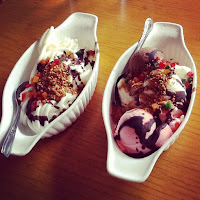
In this section, we will see the chemistry behind the recipe of ice cream. In more detail, we will see the chemistry recipe of ice cream, the processing of ice cream, and the transporting ice cream can face problems. Moreover, this section will be concluded by the future possible development of ice cream. To begin with, we will start with some figures related to ice cream.

Thermodynamics: Energy Accountancy and Thermochemistry

Image
In this section we will discuss about one of the main principles of thermodynamics which is energy accountancy. In this section, we will focus on heat transactions which is the application of first law of thermodynamics. Besides that, we will also discuss about enthalpy where the reaction happens at constant pressure. Furthermore, we will also discuss about heat capacity and adiabatic system.

Thermodynamics: The First Law, Work and Heat

Image
This section we will discuss the fundamental concepts of thermodynamics which are the zeroth and first law of thermodynamics. Besides that, we will also have a discussion about two important points related to the first law which are heat and work.

The Fundamental Theory of Gases

Image
This section we will discuss about the fundamental theory of gases as we focus on kinetic theory of gases (perfect or ideal gas), real gases, intermolecular forces, and kinetic theory. Besides that in kinetic theory of gases we will see perfect gases' state functions in term of energy and as well for real gases. In this section we will also see briefly about diffusion and effusion.

The Chemistry of Battery

Image
Most of the portable electronic devices in these day use battery as the power source. In this section, we will see how chemistry is applied into our daily life through battery. Battery is already known for a long time ago and the earliest battery was dated around 250 BC and 640 AD. It was found by Wilhelm Konig in 1938, but no one known the exact application. Many scientists suggest it might be used for electroplating. Schematic diagram of Baghdad Battery

Weizmann Institute Scientists Observe Quantum Effects in Cold Chemistry

Image
At very low temperatures, close to absolute zero, chemical reactions may proceed at a much higher rate than classical chemistry says they should – because in this extreme chill, quantum effects enter the picture. A Weizmann Institute team has now confirmed this experimentally; their results would not only provide insight into processes in the intriguing quantum world in which particles act as waves, it might explain how chemical reactions occur in the vast frigid regions of interstellar space.

Collision Theory and Boltzmann Constant

Image
The Collision theory , proposed by Max Trautz and William Lewis in 1916 and 1918, qualitatively explains how chemical reactions occur and why reaction rates differ for different reactions. This theory is based on the idea that reactant particles must collide for a reaction to occur, but only a certain fraction of the total collisions have the energy to connect effectively and cause the reactants to transform into products. This is because only a portion of the molecules have enough energy and the right orientation (or "angle") at the moment of impact to break any existing bonds and form new ones. The minimal amount of energy needed for this to occur is known as activation energy . Particles from different elements react with each other by releasing activation energy as they hit each other. If the elements react with each other, the collision is called successful, but if the concentration of at least one of the elements is too low, there will be fewer particles for the oth...