Posts

Showing posts with the label atomic structure

Atoms and the Periodic Table VI: Many Electrons System and Periodicity

Image
If we observe closely to the periodic table, the system or the pattern that is not created by single electron system such as hydrogen. Therefore, we need a different approach from what we used in hydrogen atom. In this section we will discuss about this matter and how the electron configuration for many electrons system, and its implication, the periodicity.

Atoms and the Periodic Table V: The Orbitals of Hydrogen Atom

Image
In this section, we will try to sketch the orbitals for the hydrogen atoms based on our wave function that we have split in the previous section. The equation is: Then, we can start the discussion from the radial function [ R ( r )].

Atoms and the Periodic Table IV: The Wave Function of Hydrogen Atom

Image
In this section, we are going to apply the basic rule of quantum mechanics, the Schrodinger's equation, for hydrogen atom. From quantum mechanics, we can predict the behaviour of electron in hydrogen atom, which is the where the electron likely to be. The hydrogen atom is chosen for this discussion due to hydrogen atom is the simplest system (1 electron and 1 proton), and the solution for hydrogen atom lies on the Schrodinger's equation.

Atoms and the Periodic Table III: The Wave Function

Image
Before we discuss more thoroughly about the H atom as a wave function, it might be better to have a look the older atomic model. Firstly, the Rutherford's model was not completely incorrect about the structure. Its model was built from its observation when a gold foil was shot by alpha particle. Rutherford's model only stated that electron is orbiting a nucleus, so the interaction is purely electrostatic interaction. However, the weakness of this model is the collapsing orbit of an electron. Since an electron is attracted by force from nucleus, so it is accelerating motion, and as the energy as the result of movement increases, it will collapse to the nucleus. Fortunately, this phenomena does not happen. Moreover, this structure also does not agree with the observation at the spectra. In this model it is expected to have a broad region of spectra, but in reality it appears as the line spectra.


Atoms and the Periodic Table II: Quantisation of Energy

Image
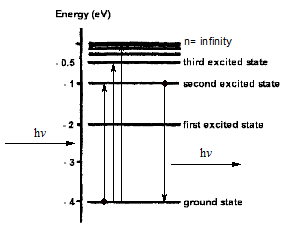
As it was discussed previously ( Atom and Periodic Table: Wave Properties ), we have seen a properties of electromagnetic radiation that is emitted from an atom as wavelength and as well a glimpse of its particle properties. In this section, we will discuss about its particle properties more thoroughly, especially related with energy, and about hydrogenic atom spectrum. In this section and later on, we will discuss about this matter by using H atom, because H atom is the simplest atomic system in the periodic table (1 electron system).

Atoms and the Periodic Table I: Wave Properties

Image
At the beginning, the atom was suggested to have a spherical shape (Dalton, ca 1700). After that, there have been a lot of researches to describe what happen inside the atom. The early modern structure of atom was suggested by Ernst Rutherford. He suggested an atom is someway similar to the solar system but there is a problem in this model. If the electron orbits the nucleus, so the interaction between electron and nucleus is electrostatic force. By this interaction, the electron will be accelerated along its orbit and it causes the electron will form have spiral orbit, and it will collapse to the nucleus with lifetime almost 0. If we refer to this model, the result in spectroscopy would show a continuous spectrum, but the result is a discrete or line spectrum. Spectroscopy itself shows interaction between matter and radiation. The theory behind spectroscopy cannot apply the classical mechanics, but another mechanics theory should be applied for object that very small such as atomic p...

Electron Configurations

Image
Aufbau Principle The Aufbau principle (from the German Aufbau meaning "building up, construction": also Aufbau rule or building-up principle ) is used to determine the electron configuration of an atom , molecule or ion . The principle postulates a hypothetical process in which an atom is "built up" by progressively adding electrons. As they are added, they assume their most stable conditions ( electron orbitals ) with respect to the nucleus and those electrons already there.

Valence Shell Electron Pair Repulsion Theory

Image
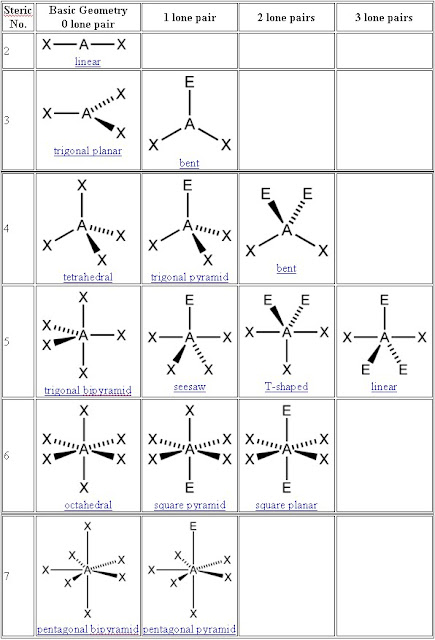
Valence shell electron pair repulsion (VSEPR) theory is a model in chemistry used to predict the shape of individual molecules based upon the extent of electron-pair electrostatic repulsion. It is also named Gillespie - Nyholm theory after its two main developers. The acronym "VSEPR" is sometimes pronounced "vesper" for ease of pronunciation.