Posts

Showing posts with the label biochemistry

Decoding Krebs Cycle II: Completing the Cycle
Image
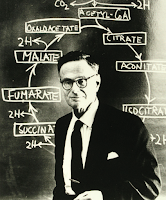
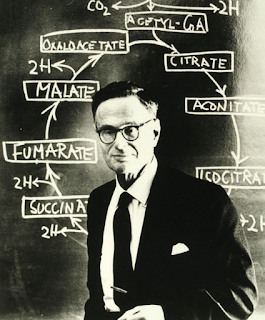
... One of the metabolic processes is called citric acid cycle (CAC) or famously known as Krebs cycle; named after its discoverer Hans Krebs. Hans Krebs himself was awarded Nobel Prize in Physiology or Medicine in 1953... In part I, we decoded half of the Krebs cycle as citrate ion (6C) is converted to succinyl-CoA (4C) after several steps. Afterwards, in succinyl coenzyme synthetase (CSC) succinate (4C) is formed from succinyl-CoA (4C) with helps of either GDP or ADP.
Decoding Krebs Cycle I: Citrate (6C) to Succinyl-CoA (4C)

Image
Hans Krebs The way living things can maintain its function, do many activities, or just simply to survive in this harsh world sometimes can be mysterious. However, there is one way to understand these mysterious processes and science, especially chemical science, can help us to understand these processes. These processes are sometimes metabolic processes and it can be seen as chemical reactions that happen in living things, from bacteria to blue whale. One of the metabolic processes is called citric acid cycle (CAC) or famously named Krebs cycle; named after its discoverer Hans Krebs. Hans Krebs himself was awarded Nobel Prize in Physiology or Medicine in 1953.

How Trivial is It to Make Amides?

Image
Amide is one of the organic functional groups that can be found ubiquitously in the nature. It plays important role in living things as the main building blocks of proteins which involve with many functions, from catalysis to structural support. Besides that, amide functionality is featured in many natural products and drugs. Examples of peptide-bearing compounds Since, it is quite common to find this functionality in natural products and synthetic compounds, a question is raised from this phenomenon. How trivial is it to make amide bond?

Cisplatin: the First-Line Drug for Nearly All Tumours

Image
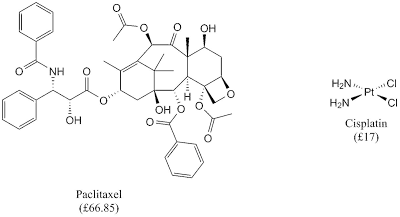
In the recent decade, chemists have taken nature as its inspiration in many ways; one of them is in medicinal chemistry. Many natural products have been screened for their bioactivities to develop new generation of therapeutic agents for 'incurable' diseases such as cancer. However, there is one major drawback from taking natural product as drug. This problem is its complex structure which makes it difficult to synthesise especially in large scale. Anticancer drugs: natural products (paclitaxel) and coordination complex (cisplatin) Luckily, a simple coordination complex, such as cisplatin, gives similar efficacy as natural product-based drug and simple coordination complex is used to treat 80% of all solid cancers. It is noteworthy that the market for this drug is around $1 billion.

Methodologies in Gas-Phase Spectroscopy for Study of Polypeptides

Image
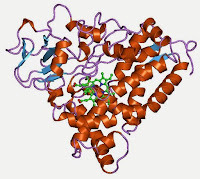
The secondary structures of proteins, such as α-helices, β-sheets, or β- or γ-turns, mainly determine the overall 3-dimensional structures of protein and these structures are mainly stabilised by interactions such as hydrogen bonding (H-bonding) and dispersion interactions. Besides that, the interaction with its biological environment also contributes to the overall structure which means the intrinsic properties of the protein are hidden. Therefore, to have a better understanding about protein structure, proteins or polypeptides must be in isolated condition where no solvent molecules are present. One of the methods that can be used to study peptides in this isolated is gas-phase spectroscopy. 3D structure of myoglobin with α-helices and random coils are shown

The Nobel Prize in Chemistry 2015

Image
The Royal Swedish Academy of Sciences has decided to award the Nobel Prize in Chemistry for 2015 to Tomas Lindahl (Francis Crick Institute and Clare Hall Laboratory, Hertfordshire, UK), Paul Modrich (Howard Hughes Medical Institute and Duke University School of Medicine, Durham, NC, USA), and Aziz Sancar (University of North Carolina, Chapel Hill, NC, USA) “for mechanistic studies of DNA repair"

Storage and Transport of Iron in Living Things

Image
Fe is known as the most abundant metal in the human body and it also comes with variety of functions such as haemoglobin ( O 2 transport in blood), myoglobin ( O 2 storage in muscle), cytochrome c (electron transfer), catalase (metabolism of H 2 O 2 ), and ribonucleotide reductase (transformation of RNA to DNA). Left to right: Haemoglobin, myoglobin, catalase, and ribonucletide reductase However, there are two major problems associated with handling it in biological system. Firstly, in aqueous environment, the stable oxidation state of Fe is Fe(III) which precipitates as the insoluble hydrated oxide [FeO(OH) ] n or rust. Besides that, free iron is also toxic as traces of high-spin Fe(II) generates superoxide radicals and hydroxyl radicals which are highly reactive and damage cells. Therefore, whole process of Fe transport and storage keeps Fe under very close control; concentration of free iron in mammals is around 10 -24 M.

Oxygen-Atom Transfer: Cytochrome P450

Image
Cytochrome P450 from Pseudomonas putida Cytochrome P450 is another example of metalloproteins that has Fe-porphyrin complex and the name P450 arieses from the absorption maximun of Fe-CO adduct at 450 nm. P450 acts as an oxidising agent and it can oxidise relatively inert and unreactive organic substrates by transfer of a single O atom. This process is known as 'mono-oxygenase' activity and it is essential for both oxidation of natural 'endegenous' products as part of metabolism and oxidation of foreign 'xenobiotic' toxins as part of their destruction. However, this activity is not selective so it can also turn relatively harmless compounds into harmful ones. Furthermore, this such control controlled oxidation of unreactive hydrocarbon under mild conditions is different in synthetic chemistry.

Biocoordination Chemistry: Oxygen Transport

Image
It is a common misconception that there is a mysterious property of organic compounds that made life possible. The pioneering research by Friedrich Wohler on the conversion ammonium cyanate to urea broke this 'vital force dogma'. In the human body, it contains around 1 kg of essential metals per 75 kg adult, from Ca as the most abundant in the body (1050 g) to some transition metals (mainly the first row transition metals). The transition metal ions are bound in proteins to give metalloproteins. Although the molecules may be complex but principles are familiar from basic coordination chemistry. A metallprotein is just a big coordination complex in which the protein acts as a polydentate ligand, controlling environment around, and behaviour of, metal ion. The main focus for this time is on the oxygen transport system in haemoglobin/myoglobin and haemocyanin. Left to right: haemoglobin, myoglobin, haemocyanin

Falling in Love: Chemically Explained

Image
Falling in love is one of the greatest gifts to humankind and also it is one of the strongest feeling that human can have. This feeling also quite interesting because every person would have different answer why they are attracted to somebody else. However, science can explain the key features when somebody is falling in love and surprisingly it is not related to heart, as many people thought, but it is related to brain activity.

The Chemistry of d- and f- Block: Trends in Stability Constant and The Application of Complex Chemistry

Image
In this section, we will see the trends in stability constant where the ligands and the metal ions are changed. We will see some patterns that build up this concept about the trends and end up in hard and soft acid base theory. Lastly, in this section we will see how complex chemistry is used in our daily life.

Radicals and Us II: Radicals and Our Life

Image
In this section, we will continue our discussion in radicals and we will discuss about the radicals in our life. In this case, we will see how radicals play prominent roles in antioxidant and immune system of body, and also in the atmosphere as it affects the climate of the Earth.

Chemistry of the Clinic - Blood

Image
This part will have a look how chemistry can be applied in healthcare and in this part will have a look for materials that have contact with blood and use in cardiovascular (heart and the blood vessels). As an introduction, the world healthcare market is approximately  £ 4000 billion and globally, the pharmaceutical market is estimated to be  £200 billion. Besides that, the world medical device markets have been estimated to be around  £120 billion and regenerative medicine is estimated worth  £1 000 billion by 2020. Synthetic materials in the body

Washing It All Down: The Chemistry of Drinks

Image
As human being which comprises of 60% of water, liquid consumption is important to fulfill the nutrition as well for pleasure. In this section we will try to see the chemistry inside of our daily drinks. Since there are a lot of type of drinks or beverage in our daily life, we only discuss 3 types; Coca Cola, tea and coffee, and wine. The drinks

The Chemist's Recipe II: Spaghetti Bolognese

Image
Spaghetti Bolognese In this part, we will encounter another food recipe, spaghetti bolognese, from the point of view of a chemist. Spaghetti bolognese is a simpler dish than rice curry as we saw in previous article, but in point of view of a chemist is still a complicated dish as it comprises a lot of ingredient. In this section, we will try to focus on the main ingredients; garlic, lycopene from tomatoes, olive oil, and cooking meat. We will not discuss about the pasta because it is simply carbohydrate in similar way as rice (have a look in curry recipe ).

The Chemist's Recipe I: Curry Rice

Image
In this section, we will have a look the chemistry inside curry rice. We will have a brief description about the key chemicals inside this recipe as well the bioactivities of the molecule which has the function as nutrient. The Art of Cookery (1747) by Hannah Glasse Before we discuss the chemical compounds on curry and rice, it is better to have a quick overview about its history. The term of curry was used in English long before arrival of traders to the subcontinent and the first curry recipe in Britain appeared in The Art of Cookery Made Plain and Easy by Hannah Glasse in 1747. However, the early recipes did not include hot spices because chili plants were not introduced to India until the 1500's.

The Chemistry of Vitamins

Image
In this section, we will see about healthy eating, which will focus on the vitamins. Besides that, the chemistry of vitamin which helps to maintain the immune system will be discussed briefly. Moreover, since there are a lot of types of vitamin, we will see only vitamin A, C, and E in this section; vitamins is also about nutrient and neutraceutic. Vitamin B12

The Nobel Prize in Chemistry 2012

Image
The Royal Swedish Academy of Sciences has decided to award the Nobel Prize in Chemistry for 2012 to Robert J. Lefkowitz (Howard Hughes Medical Institute and Duke University Medical Center, Durham, NC, USA), and Brian K. Kobilka (Stanford University School of Medicine, Stanford, CA, USA) "for studies of G-protein–coupled receptors"