Posts

Showing posts with the label natural products

A (Brief) History of the Chemistry of Natural Products

Image
In these days, the chemistry of natural products is still a massive attraction for chemists, especially organic synthetic chemists. New substances, more or less complicated, more or less useful, are constantly discovered and investigated with all the techniques and tools that the early organic chemists could only imagine. In the course of these studies, the researchers are challenged by the preparation of the compounds which somehow drives this field forward. This time, we'll see the historical perspective of this 'ancient' research field and also future prospective that chemistry of natural products can offer.
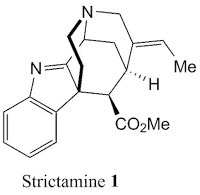
Strictamine

Image
It was isolated for the first time in 1966 from the plant Rhazya stricta , strictamine (1)  has been a great interest due to its unique properties. Strictamine belongs to the group of akuammiline alkaloids which is the family of monoterpenoid indole alkaloids. This compound has been showed to inhibit the nuclear factor-𝜅B (NF-𝜅B), which plays an important role in immune and inflammatory responses. Apart from its bioactivity, strictamine has attracted synthetic chemists because its structure bearing a tricyclic unit of methanoquinolizidine. This interesting challenge causes only four groups - Garg (enantioselective), Zhu (racemic), Ohno (formal synthesis), and Gaich (formal synthesis) - have managed to complete a total synthesis of strictamine. This time on " Totally Synthesised" , we will see synthetic strategy by Gaich's group which used [2,3]-Stevens rearrangement to build the methanoquinolizidine unit.

Eleutherobin

Image
The generosity of mother nature is limitless and it will not stop giving for humankind to thrive. Besides that, nature has been a close friend with chemists especially organic chemists. Complex structures of natural products have been a great interest as it provides to develop synthetic methods to synthesise natural products. One of the 'hunting grounds' of synthetic organic chemists is the sea, and one of the products is called eleutherobin, 1 . Eleutherobin can be isolated form a species of marine soft corals Eleutherobia  collected in the Indian Ocean near Bennett's Shoal in Western Australia. Despite its rarity, eleutherobin is a potent compound against selected breast, renal, ovarian, and lung cancer cells. This highly potential compound drove Nicolaou's group to synthesise this compound.

Ecteinascidin 743

Image
One of the main attractions in the chemistry of natural products, apart from facing new challenges in synthetic methodologies, is discovering a novel therapeutic agent such as ecteinascidin 743 (ET-743) . This compound was isolated for the first time as pure compound from Caribbean tunicate Ecteinascidia turbinata in 1986 by Rinehart's group. This compound possess interesting properties as a potent anti-tumour agent and ET-743 is approved in Europe, Russia and South Korea for treatment of advanced soft tissue sarcoma. From synthetic chemists' point of view, ET-743 provides an interesting challenge as it has interesting molecular architecture; comprised of eight rings, including 10-membered heterocycles and 8 stereogenic centres. This interesting molecular architecture and interesting anti-tumour properties were the motivation of its first total synthesis by E. J. Corey in 1996.

Cytovaricin

Image
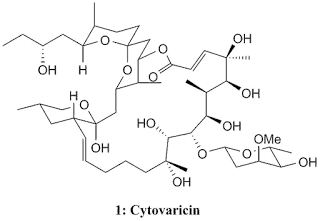
Cytovaricin, 1 , was isolated by Isono's group in 1981 from a culture of Streptomyces diastatochromogenes and the structure was elucidated in 1983 from X-ray crystallography. From its structure, cytovaricin was revealed to have such an elegant and complex structure with 22-membered macrolide structure as its framework and possessing 17 stereocentres, a spiroketal, and a glycoside unit giving four more stereocentres. This highly complex molecule give a unique challenge to organic chemists in asymmetric synthesis. The structure elucidation of cytovaricin was triggered from the finding that it is a potent inhibitor against sarcoma cells in tissue culture which makes cytovaricin a new potential as antineoplastic antibiotic. Besides that, cytovaricin appears to be related biogenetically to the oligomycin/rutamycin antibiotic family.

Resiniferatoxin

Image
If you think capsaicin is hot enough for you, you might want to think again. One of the member of a big family of daphnane diterpene is way beyond capsaicin in Scoville scale. This compound scores 16,000,000,000 Scoville Heat Unit (SHU) which is 1000 times than capsaicin itself. This chemical can be found in resin spurge ( Euphorbia resinifera ) and it is known as resiniferatoxin   (RTX).

Bongkrekic Acid

Image
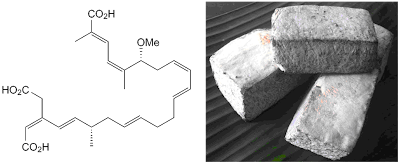
Previously in Totally Synthesised, a chemical compound called tetrodotoxin from a puffer fish makes a plate of deadly sashimi from Japan. This time a delicacy from Indonesia known as tempe bongkrek  and it is made from a fermented coconut press cake. However, a contaminated tempe bongkrek with bacterium Burkholderia cocovenans  causes this food becomes toxic due to a chemical produced by the bacterium which is bongkrek acid or bongkrekic acid. Bongkrek Acid and Tempe Bongkrek

Zaragozic Acid A/Squalestatin S1

Image
In 1992, a family of structurally related natural products was isolated from various fungal cultures by researchers at Glaxo and Merck. This chemical family is known as the squalestatins and the zaragozic acids, named after Province of Zaragoza, where the fungi were found. One of the members of the zaragozic acids/squalestatins family is zaragozic acid A/squalestatins 1. Zaragozic acid A and coat of arm of Province of Zaragoza

Amphotericin B

Image
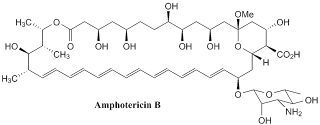
It was orginally extracted from a bacterium Streptomyces nodosus in 1955 at the Squibb Institute of Medical Research. This compound is called amphotericin B and now it is listed on the World Health Organisation's List of Essential Medicine , which is the list of the most important medications needed in basic health. Amphotericin B works as antifungal drug and is often used intravenously for systemic fungal infections. The name of amphotericin B is derived from its amphoteric property.

Tetrodotoxin

Image
Sashimi is one of the most famous Japanese cuisine which is made from raw fish. One of this delicacy and the most expensive one is made from a species of pufferfish which is known as fugu in Japan, the most notable one is torafugu or tiger pufferfish ( Takifugu rubipes ). One thing that make this type of sashimi is so expensive is due to labourous preparation and the adequate preparation is necessary since this fish is so toxic. This high toxicity is due to a compound called tetrodotoxin (TTX).