Posts

Showing posts with the label kinetics

Dissipative Self-Assembled Vesicular Nanoreactor
Image
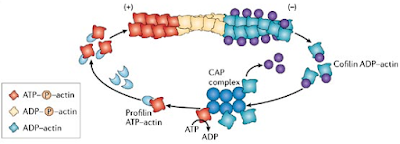
In nature, self-assembly has been exploited in many ways to create molecular systems for biological processes. This idea has inspired many chemists in recent decade to use self-assembly to access various function of molecular level. However, there is a major difference between the synthetic and natural self-assembled systems. The synthetic self-assembly produces the most thermodynamically stable product. On the other hand, many natural self-assembly processes are energetically uphill and require a continuous consumption of energy to maintain its structure; this is referred as dissipative self assembly. The formation and dissociation of actin filament, one of the example dissipative self-assembly. (J. Baum, A. T. Papenfuss, B. Baum, T. P. Speed, and A. F. Cowman, Nature Rev. Microbiol. , 2006, 4 , 621-628) Recently, researchers from University of Padova successfully found a novel strategy for the dissipative vesicular structure that are stable to maintain its shape in the present ...
Free Radical Polymerisations

Image
Chain polymerisation is probably the most common polymerisation that is widely used, either for lab or industrial scale and one the example is free radical polymerisation. There is an obvious reason why this is callen free radical polymerisation and it is simply due to using radical species as the active species. In the same way with step polymerisation , this section will discuss mainly about ita kinetics.

Step Polymerisations

Image
One of the processes to make polymers is called step polymerisation and this process used to be called a condensation polymerisation due to the formation small byproduct or condensate. In this section, we will see the chemistry behind step polymerisations especially in polyesterification and its kinetics.

Collision Theory and Boltzmann Constant

Image
The Collision theory , proposed by Max Trautz and William Lewis in 1916 and 1918, qualitatively explains how chemical reactions occur and why reaction rates differ for different reactions. This theory is based on the idea that reactant particles must collide for a reaction to occur, but only a certain fraction of the total collisions have the energy to connect effectively and cause the reactants to transform into products. This is because only a portion of the molecules have enough energy and the right orientation (or "angle") at the moment of impact to break any existing bonds and form new ones. The minimal amount of energy needed for this to occur is known as activation energy . Particles from different elements react with each other by releasing activation energy as they hit each other. If the elements react with each other, the collision is called successful, but if the concentration of at least one of the elements is too low, there will be fewer particles for the oth...