Posts

Showing posts with the label about compounds

The Chemistry of Water

Image
In this section we will have a brief overview about one of the important ingredients of life, which is water ( H 2 O ). We will have a discussion around the properties of water and some anomalous properties of water. Lastly, we will have a brief look about the latest technology to address the problem about clean water.

Phosphazene

Image
Phosphazenes are a class of chemical compounds in which a phosphorus atom is covalently linked to a nitrogen atom by a double bond and to three other atoms or radicals by single bonds. While other substitutions produce relatively persistent compounds, in organic synthesis the term largely refers to species with three amino substituents bound to phosphorus. The compounds are unusually stable examples of the phosphorane class of molecules and have a remarkable proton affinity. As such, they are one of the eminent examples of neutral, organic superbases. Two examples are hexachlorocyclotriphosphazene and bis(triphenylphosphine)iminium chloride. Phosphazenes are also known as iminophosphoranes and phosphine imides . The corresponding polymers are polyphosphazenes. Phosphazene bases Phosphazene bases are strong non-metallic non-ionic and low-nucleophilic bases. They are stronger bases than regular amine or amidine bases such as Hünig's base or DBU. Protonation takes place at a ...

Triflic acid

Image
Trifluoromethanesulfonic acid IUPAC name Trifluoromethanesulfonic acid Other names Triflic acid Identifiers CAS number 1493-13-6   PubChem 62406 ChemSpider 56192   ChEBI CHEBI:48511   Jmol -3D images Image 1 Properties Molecular formula CF 3 SO 3 H Molar mass 150.08 g/mol Appearance Colorless liquid Density 1.696 g/mL Melting point -40 °C Boiling point 162 °C Solubility in water Miscible Hazards Main hazards Corrosive, eye irritant   (what is this?)    (verify) Except where noted otherwise, data are given for materials in their standard state (at 25 °C, 100 kPa) Infobox references Trifluoromethanesulfonic acid , also known as triflic acid , TFMS , TFSA , HOTf or TfOH , is a sulfonic acid with the chemical formula CF 3 SO 3 H. It is one of the strongest acids . Triflic acid is mainly used in research as a catalyst for esterification . ...

Meldrum's acid

Image
IUPAC name 2,2-Dimethyl-1,3-dioxane-4,6-dione Identifiers CAS number 2033-24-1 PubChem 16249 Properties Molecular formula C 6 H 8 O 4 Molar mass 144.13 g mol −1 Melting point 94-95 °C (decomposes) Acidity (p K a ) 4.97 Except where noted otherwise, data are given for materials in their standard state (at 25 °C, 100 kPa) Meldrum's acid or 2,2-dimethyl-1,3-dioxane-4,6-dione is an organic compound . The compound was first made in 1908 by Andrew Norman Meldrum by a condensation reaction of malonic acid with acetone in acetic anhydride and sulfuric acid . Meldrum misidentified the structure as a β- lactone of β-hydroxyisopropylmalonic acid. The correct structure is shown on this page. The synthesis of Meldrum's acid.

Sulphuric Acid

A molecule of Sulphuric Acid, H2SO4, consists of two atoms of hydrogen, one atom of sulphur and four atoms of oxygen Sulphuric acid is a colourless viscous corrosive oily liquid, which has Melting Point : 10.3 degC Boiling Point : 338 degC Formula weight 98.08 Specific gravity or density 1.94 Flash point none

Nitric Acid

Properties of Nitric Acid Nitric Acid displays the properties of a strong acid and it is a powerful oxidising agent. Reactions of Nitric Acid

Clathrate compound

Image
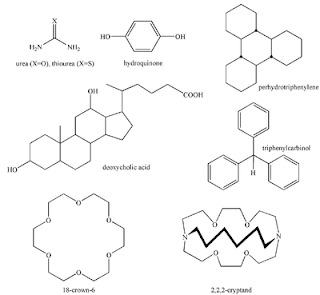
A clathrate, clathrate compound or cage compound is a chemical substance consisting of a lattice of one type of molecule trapping and containing a second type of molecule. The name clathrate complex used to refer only to the inclusion complex of hydroquinone, but recently it has been adopted for many other weak composites which consist of a host molecule (forming the basic frame) and a guest molecule (held in the host molecule by inter-molecular interaction). Clathrates are also called host-guest complexes, inclusion compounds, and adducts (chiefly in the case of urea and thiourea). They used to be called molecular compounds. A clathrate hydrate, in particular, is a special type of gas hydrate in which a lattice of water molecules encloses molecules of a trapped gas. Large amounts of methane naturally frozen in this form have been discovered both in permafrost formations and under the ocean sea-bed. Researchers have begun to investigate silicon and germanium clathrates for possible...